
stars, lost souls, and "life-writing"
analysis and finding belonging in Kaveh Akbar's Martyr! (and more)

I have picked the stars from the midsummer nights in the Shiraz of my childhood and youth, and the jasmine blossoms from grandma’s prayer rug where she kept them.
—Fatemeh Keshavarz, Jasmine and Stars: Reading More than Lolita in Tehran
Hey all! I have been meaning to put something on this Substack other than my deepest fears and insecurities for quite some time, so hopefully this project I did for my literature seminar can be a nice change of pace. It’s more of a book review than anything (spoilers ahead!), but it’s also commentary about something bigger (as most things are). I also wrote this entire thing before the “ceasefire” between the U.S. and Iran was announced, but literally who knows what is real at this point?
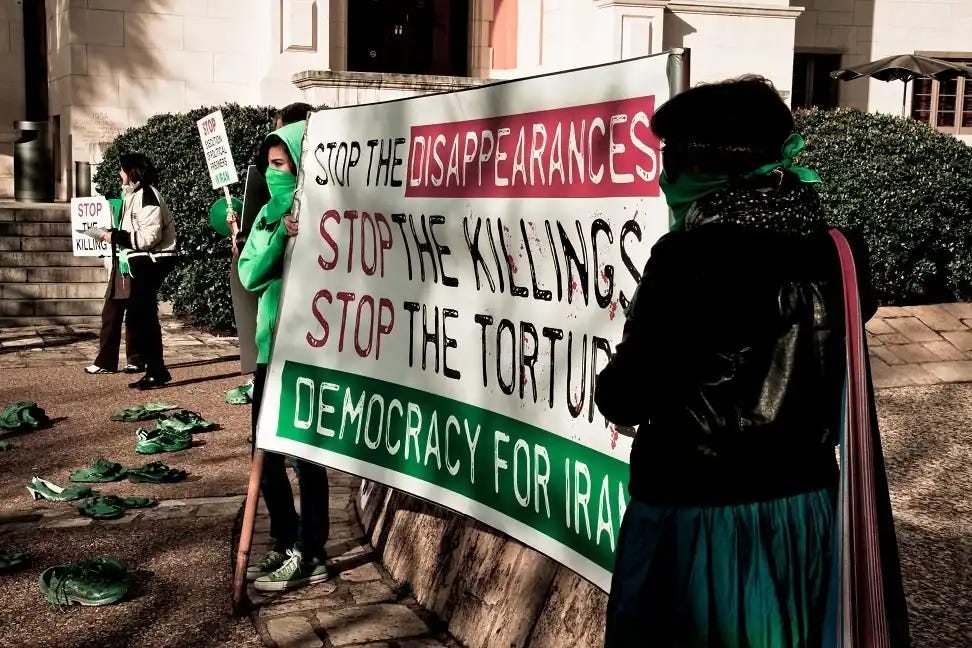
In a period so heavily defined by Middle Eastern conflict, genocide in Palestine, and the conflict with Iran, some scholars have expressed concern over emerging “New Orientalist” narratives that flatten and oversimplify Middle Eastern cultures and peoples.
In this moment, Iranian people and culture are sometimes deemed synonymous with their authoritarian government, a rhetorical strategy that aims to make threats of nuking the country and that an “entire civilization will die” in the process somehow seem reasonable.
The political implications of this are daunting and are already affecting the Iranian-American diaspora (which just means a dispersion of people from their homeland). Kourosh Ziabari writes in an article for New Lines Magazine that just one week after the U.S. attacked Iran in June 2025, a year ago now, “183 Iranians were taken into custody by federal immigration authorities, whereas only five had been arrested a week prior.”
Ziabari speculates that the timing of the Iranian-American ICE arrests was not coincidental. He believes that it is “a bid to send a chilling message to the Iranian-American community, and not merely to the Iranian regime.”
In other words, Iranians and Iranian-Americans are not welcome in a country of mostly immigrants.
Therefore, positive representations of Iranian-Americans in the media to combat this narrative are crucial. And if you’re as chronically on Bookstagram as I pretend not to be, you might know that Kaveh Akbar has emerged as one of the most important writers in this space.
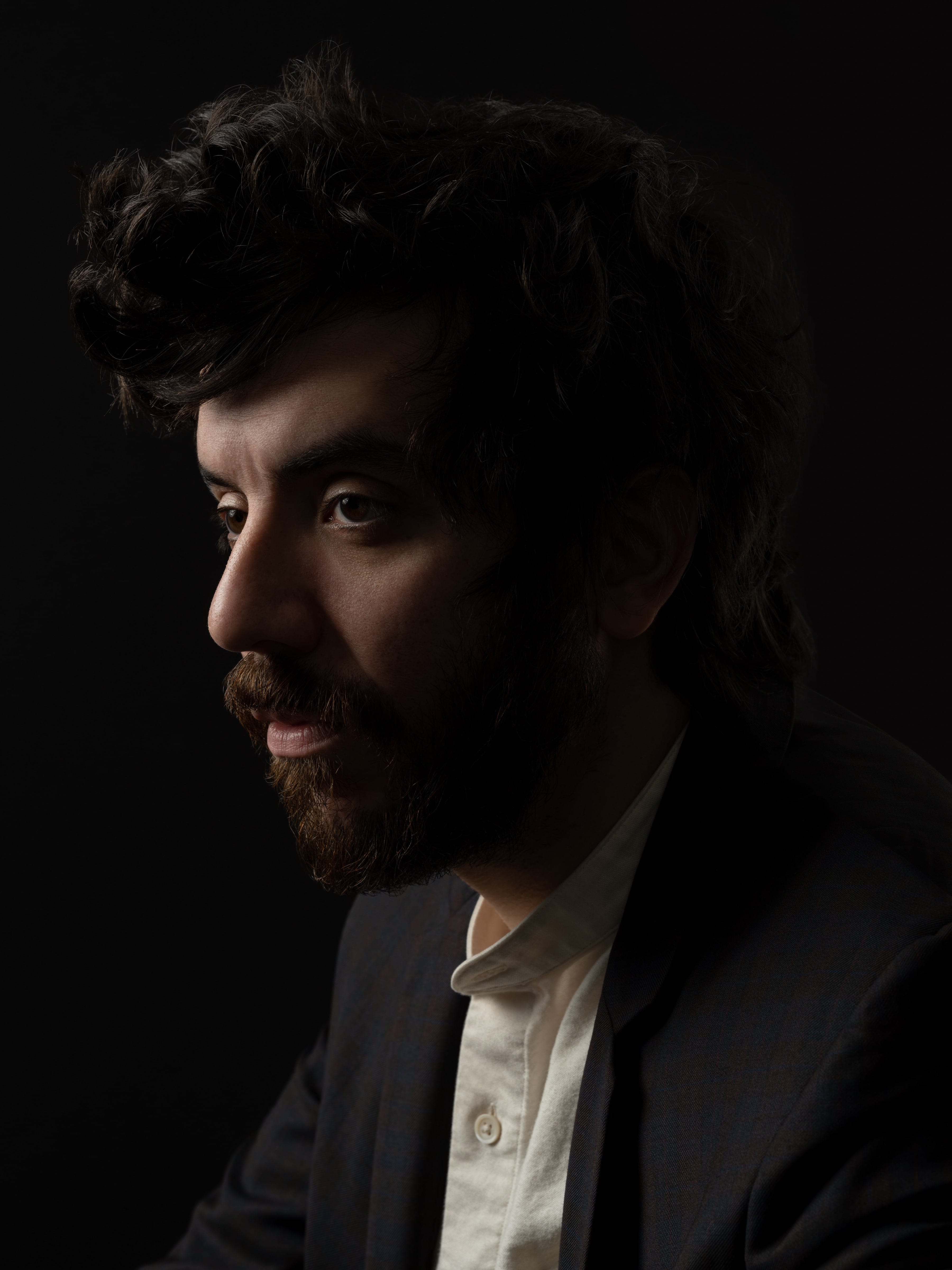
Akbar, born in Tehran, Iran and now the Roy J. Carver Professor of English at the University of Iowa, probably wants the reader of his 2024 semi-autobiographical debut novel Martyr!1 to see the protagonist Cyrus Shams first and foremost as a man. He is a broken, hurting man, and his Iranian-American identity is just one aspect of that.
Cyrus is a first-generation immigrant, recent college graduate, and poet. He struggles with addiction recovery and questions of his larger purpose in life. He is obsessed (slight understatement) with the concept of martyrdom and is working on a long-form writing project exploring some of the most well-known martyrs in history. Joan of Arc. Malcolm X. Bobby Sands. Each person becomes a poem, a shrine, something more than themselves that Cyrus can grasp.
This fascination stems largely from unresolved grief and anger over the death of his mother. Supposedly, she was killed in 1988 in Iran Air Flight 655, which was shot down by the U.S. Navy after misidentifying it as a fighter jet. (That part is not fiction at all, by the way. 290 people were killed and the United States never formally apologized or accepted legal accountability, though it occurred in the Iran-Iraq war.)
Akbar’s Martyr! depicts the Iranian-American diasporic experience as fragmented as a mosaic. Like other marginalized peoples, they are shaped by multiple intersecting identities, including the ever-present looming threat of political violence between the U.S. and Iran, a sense of national displacement, and in Cyrus’s case, queerness. Consequently, members of the diaspora are caught in an “in-between” state, feeling unwelcome in the country they immigrated from and the place they immigrated to.
However, Akbar reveals that a source of belonging for Iranian-Americans can be found through constructing a “self-narrative” – that is, writing about one’s own life experiences and retroactively finding meaning through the end result. In doing so, they can resist reductive New Orientalist narratives about their culture.
To begin, one must understand the current state of cultural and political tensions between the United States and Iran, which began long before 9/11. Maria Wagenknecht writes in Constructing Identity in Iranian-American Self-Narrative2 that after the American-imposed Shah Mohammad-Reza Pahlavi was overthrown in the 1979 revolution, many Iranians began immigrating to the United States in several waves consisting of everyone from academics to socialist revolutionaries to women and laborers due to further human rights abuses under the new regime. Although many of these immigrants have a neutral or even positive view of America, politicians still use rhetoric making them synonymous with the totalitarian Iranian regime (which came to be in part due to American colonialist tendencies).
Fatemeh Keshavarz’s Jasmine and Stars3 was written to dismantle many constructed “New Orientalist” narratives in literature that portray Iranian people and culture in stereotypical, Eurocentric ways, often from the perspective of an “insider” or a person who actually lived in Iran. Keshavarz argues that the emerging New Orientalist narrative, while not as overtly colonial as the original Orientalist movement, is equally destructive because it erases the nuance, complexity, and richness of local cultures in favor of sensationalized stories that Western readers (and publishers) gravitate towards. For instance, she argues that in Azar Nafisi’s Reading Lolita in Tehran,4 “the book’s erasure of the voices of sanity reduces the entire culture to the behaviors of its extremists” and nearly every man who actively practices Islam is faceless, devoid of dialogue, and abusive towards one of the central female characters (111).
Keshavarz’s approach of more empathetically approaching Iranian culture and literature is a useful framework for examining Martyr! because it can be seen in many ways as an anti-New Orientalist novel. This is crucial for an Iranian-American’s sense of self and belonging to America because rejecting the New Orientalist narrative allows the protagonist Cyrus to exist independent of political violence, displacement, or stereotypes of Muslim men.
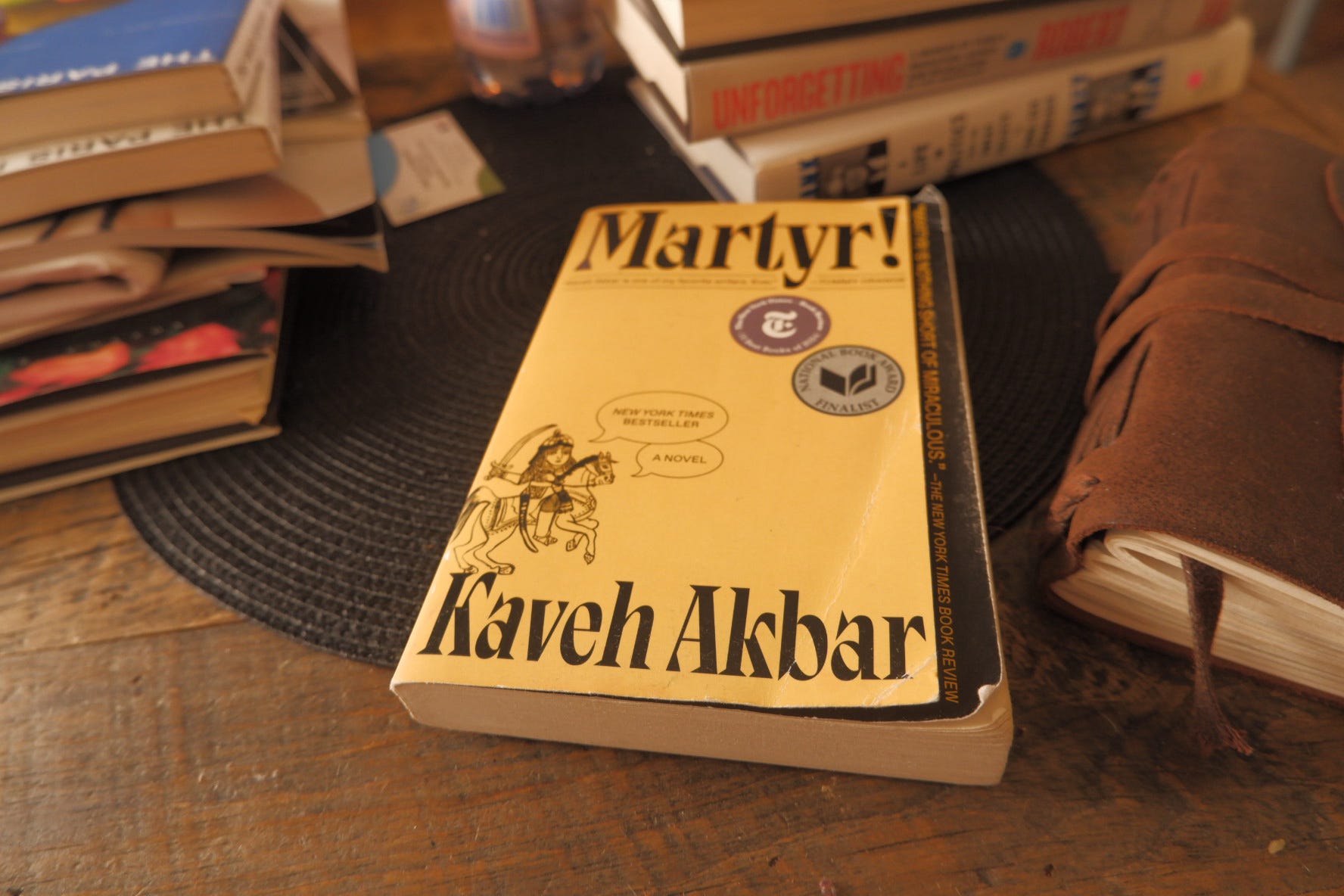
At the onset of the novel, Cyrus is described as a recovering alcoholic and addict stuck in a mundane job doing trivial work he hates (as most of us are right now, it feels like), pretending to be a dying patient for medical students. In any case, a college-age person going through an extreme depressive episode could relate to his dissatisfaction.
However, his personality is not exclusively limited to a being of suffering and internal torture. In between, the reader witnesses moments where the poet in Cyrus emerges, and he attends a weekly open mic at a coffee shop with his “roommate” Zee. Though the two have a somewhat complicated relationship that dips into romantic and sexual but never achieves a proper label, much to Zee’s chagrin, their open mic nights together are filled with laughter, live music, and poetry readings, “a healthy way to spend the time they were no longer using to get drunk or high” (72).
Cyrus’s childhood flashbacks, too, are laced with the pain of his mother’s supposed death on Iran Air Flight 655 and his father being chronically overworked and an alcoholic. However, there are glimmers of childhood and innocence throughout, such as his mistaking root beer at a school field trip to Chuck E. Cheese for actual beer and, fearing he is doomed to a life of alcoholism, spent “the rest of the week preparing to die” (52).
While moments like this may foreshadow Cyrus’s later obsession with death, here it is played more for humor: to let him be a naive, innocent child just for an instant. In all of these instances, Cyrus is depicted as more than just a suffering Iranian-American child or struggling gay man with no clear purpose or direction. This directly contrasts the narrative of faceless, voiceless Iranian men present in Reading Lolita in Tehran. We can nearly see the face of Cyrus, and certainly hear his voice.
So we, as readers, understand Cyrus to be more than a product of the politically tense moment he was born into—but how does he make sense of himself and see beyond the version of himself that’s been imposed upon him and internalized? So much of the novel is introspective, even circular, with his thoughts perpetually turning to the perceived “meaninglessness” of his parents’ death, his uncle’s irreversible war trauma, and his desire to give himself a meaningful death. He grapples with the duality of being Iranian and American, admitting that he fears becoming a cliché and being seen as just “another death-obsessed Iranian man” (101) but in another moment of anguish expresses that he wants “to be worthy of the great terror [his] existence implies” (216).
This obsession with meaning and meaninglessness, martyrdom of a holy or physical cause, culminates in a project that Cyrus tentatively titles “BOOKOFMARTYRS.docx”. Rather than allowing the death of his loved ones, and particularly his mother, to remain “meaningless,” he explores the concept of martyrdom through poetry alluding to famous historical figures like Joan of Arc or Hussain in addition to his family members, placing them on the same pedestal. In the file, Cyrus writes that “there is an unforgivable hubris in [his] imagining any part of their living, and presuming to write about it … [but] there is also hubris in writing about anything else” (106). This declaration—particularly the phrase “imagining any part of their living”—reveals the Book of Martyrs to be a kind of meaning-making, diasporic, critical fabulation project for Cyrus.
In non-academic speech: he’s trying to recapture the voices of his mother, father, and uncle to make sense of their lives and what they were like.
There is a precedent for this in Iranian-American literature and history. Wagenknecht argues that “autobiographical texts have emancipatory impact: they lend voice and agency to ethnic Americans and help further a positive self-imagination and group history” (9). This echoes the sentiment of Toni Morrison’s Playing in the Dark: Whiteness and the Literary Imagination,5 which implies that controlling one’s own written narrative is a potent way of resisting the narrative written by an outside force.
Interestingly, Wagenknecht points out that this is an especially recurring theme in Iranian literature. She says that Iranian autobiographical writings have a “tendency toward fiction, whereas fictional writing often appears to be autobiographically influenced” (12). Rather than using traditional western literary terms such as “autobiography” or “memoir,” Wagenknecht employs the phrase “life-writing” as an umbrella term for nonfiction and fiction that is directly inspired by an author’s culture and life experiences.
This “life-writing” framework brings a whole new interpretation to many sections of the novel that are written in perspectives from the past. For instance, chapters devoted to Roya, Cyrus’s mother, are written in first person (in contrast to the third-person perspective of Cyrus’s chapters) though there is no truly realistic way that she might have written them herself, and Orkideh (which Roya changes her name to after she arrives in the U.S.) never tells Cyrus any of this. Considering the “imagining any part of their living” phrase used by Cyrus in the Book of Martyrs, I propose that these chapters could be, within the world of the novel, written by Cyrus himself and are part of his project. If this were true, Cyrus is “emancipating” his mother, father, and uncle’s stories and lending them agency that they were not given in their own life. This retroactively gives their deaths meaning; or more specifically, it allows him to give them meaning beyond just an unfortunate tragedy, in the case of his mother.
Particular emphasis should be placed on the role that life-writing plays for Cyrus’s intersecting identities beyond just being Iranian-American. For instance, writing from the perspective of his mother—who he discovered preferred women and was in love with a woman named Leila—may have helped them bond, if indirectly, over their shared queerness. Imagining how his mother must have felt, trapped in a loveless marriage when the woman she loved was within reach, could have played a role in Cyrus coming to terms with his feelings for Zee. Knowing that his mother had somewhat similar experiences could make him feel less alone.
Here, again, Akbar refuses to conform to the New Orientalist narrative of every Muslim in the Middle East being homophobic and every man being abusive towards his wife. Though Roya felt confined in her marriage with Cyrus’s father Ali, she bade him no ill will. Cyrus learns from a woman named Sang, who was briefly married to Orkideh later in her life, that his father likely knew about the affair, but it was “Leila’s husband finding out” that caused them to leave, and not any action of Ali’s (301). Though indirect, this indicates the diversity of opinions towards lesbian couples by Iranians, with not every citizen believing the same thing. Roya states too, in the chapter that may or may not be written by her, that “[she] felt guilty for hardly thinking about Ali,” heavily implying that they had a genuinely respectful relationship (282).
After learning from Sang that Roya had survived, switching identification papers with Leila and having her board the doomed plane before escaping to the U.S. and renaming herself Orkideh, Cyrus understandably feels conflicted. After all, he had been speaking to her all along, and she knew perfectly well who he was and had never told him or sought him out.
It is through the life-writing as his mother, however, that he comes to terms with the fact that she was forever changed by Leila’s death; he imagines her as “happy. Not always, not even mostly. But [she] did know real, deep joy. Maybe everyone gets a certain amount to use up over a lifetime, and [she] just used [her] lifetime’s allotment especially quickly, with Leila” (294).
Under this theory, Cyrus writes from the perspective of his mother to see the value, the richness of her life, seeing beyond her tragedies and martyrdom. He uses this “life-writing” to reframe a tragically short (or, what he thought was short) life as one spent full of passion, burning fiercely before being snuffed out, like a faraway supernova. This retelling of his mother’s story makes her absence in his life a bit easier to bear, as Cyrus knows Roya had achieved her allotted joy.
The revelation that Roya did not die in the plane does, admittedly, complicate the project built around her martyrdom. If she chose to disappear, what becomes of every poem Cyrus wrote in her name? He had anticipated this kind of failure himself, even calling it “unforgivable hubris,” and the twist proves him right in ways he couldn’t have predicted. Yet it also clarifies what life-writing can and cannot do. Sang provides the facts: Roya survived, she loved Leila, and she became Orkideh. But facts alone cannot restore a soul. Roya’s voice, the guilt she felt about Ali, and her finding “real, deep joy” is something that was lost and reinvented by Cyrus. Though the hubris was real, it was also necessary, because no other mode of knowing could have reached her true self. It is through the BOOKOFMARTYRS.docx and these perspective chapters that Cyrus gains a better sense of himself and his family.
But ultimately, Martyr! does not offer a clean resolution. It’s not satisfying at all, and that is literally the point, as much as it hurts.
In the novel’s dream-like final few pages, everything seems a bit blurred and out of focus. NYC ripples and changes around him like a pond in pouring rain. Look up the Reddit discourse surrounding the ending and nobody can agree on what it means. Does Cyrus actually reunite with Zee? Does he die of hypothermia, finally alone? Maybe the best story is the one you choose yourself.
Akbar, himself an Iranian-American poet, performs the same “life-writing” act in creating the novel. He restores interiority and complexity to Iranian-American lives that the dominant political narrative would prefer to keep flat, yet threatening. As Ziabari’s reporting makes clear, the stakes of that narrative are not abstract.
Martyr! insists that in order to resist being written by others—reduced to a threat, a statistic, a civilization that the so-called “President Invective” (a thinly-veiled codename for the current one) could arbitrarily choose to erase—you must write yourself, messily and presumptuously, into existence. You must dare to title a novel Martyr! with an exclamation point, as if insisting upon yourself, shouting from a rooftop towards ever-listening stars.

Thanks for making it this far. From here, I’d highly, highly recommend getting the book yourself, even if I kinda spoiled the whole thing—it won a bunch of fancy awards and it genuinely changed my life on top of that because it’s insanely well-written (I have never seen someone write so closely to the weird way I think). Bookshop.org links to everything I mentioned are below!